
Simple FPGA Guide for High-Speed Trading
FPGAs (Field-Programmable Gate Arrays) are transforming high-speed trading by offering ultra-low latency and deterministic performance. These reconfigurable hardware devices process tasks at hardware speed, bypassing traditional operating system delays. For futures traders, this means faster trade execution - often in under 500 nanoseconds - and a competitive edge in markets where timing is critical.
Key Takeaways:
- What is an FPGA? A hardware device programmed to execute specific tasks directly, unlike CPUs, which process sequentially.
- Why use FPGAs in trading? They minimize latency, ensure consistent execution times, and handle tasks like order book updates and risk checks faster than CPUs or GPUs.
- Latency Benefits: Tick-to-trade times as low as 150–300 nanoseconds compared to 100+ microseconds for software-based systems.
- Use Cases: Market data parsing, order book management, strategy execution, and pre-trade risk checks.
- Beginner Hardware: Affordable boards like the Xilinx PYNQ-Z2 (~$200) are great for learning before scaling to institutional-grade hardware.
FPGA systems are ideal for traders who prioritize speed and precision. Paired with platforms like NinjaTrader and top VPS providers for futures trading, FPGAs can handle time-sensitive tasks while software focuses on strategy management. While the upfront cost of high-end FPGA hardware can be steep ($50,000+), the performance gains can significantly impact trading outcomes.
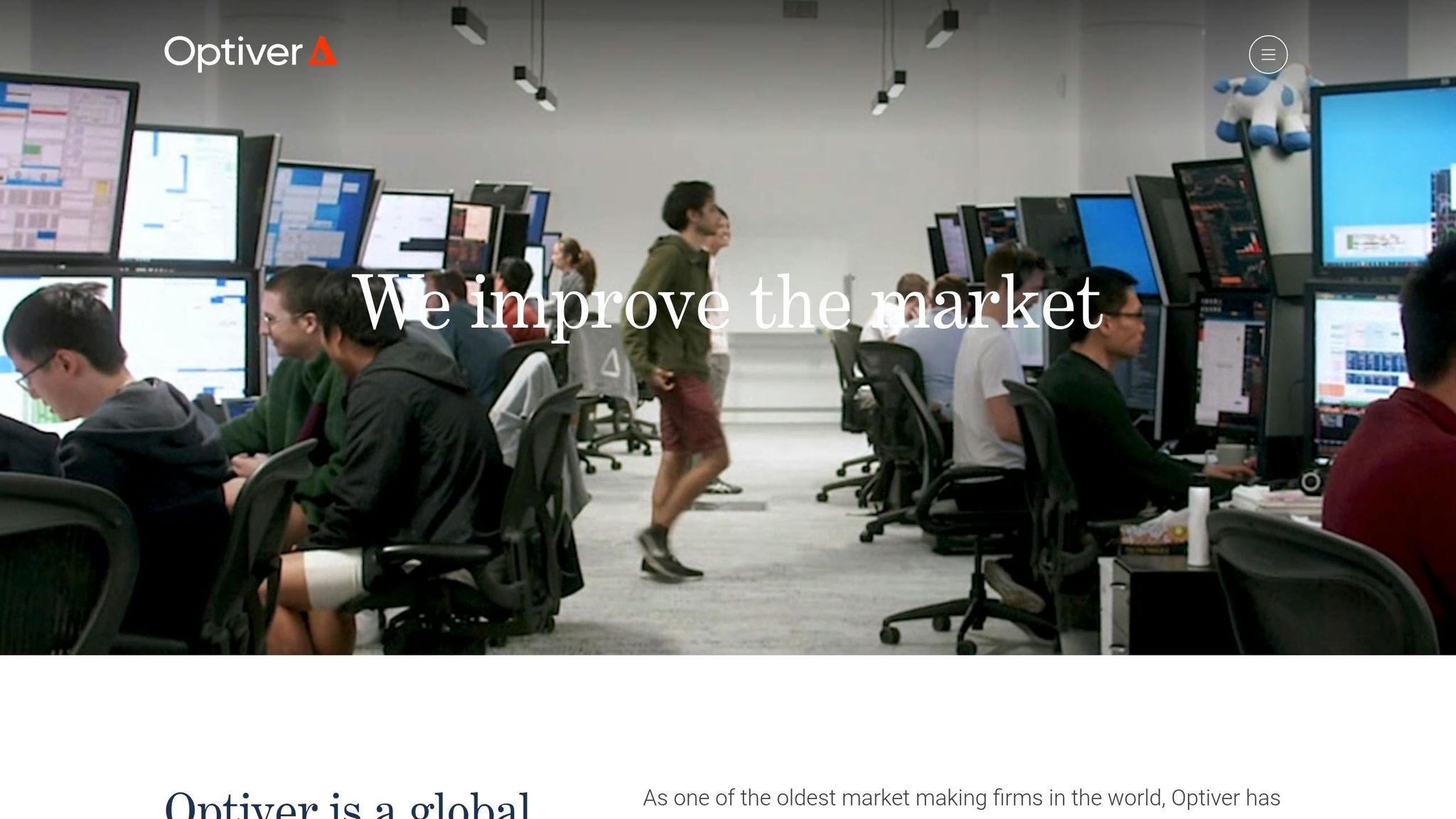
FPGAs and low latency trading - Williston Hayes - Optiver - FPL2020
FPGA Basics Explained

FPGA vs CPU vs GPU vs ASIC: Latency & Trading Performance Compared
Key FPGA Components and Architecture
An FPGA operates using a grid of programmable logic blocks, which can be configured to create custom circuits. At the heart of this architecture are Configurable Logic Blocks (CLBs). Each CLB contains Look-Up Tables (LUTs) - small memory units that perform specific logic operations directly in hardware [1]. Think of LUTs as tiny decision tables that instantly produce results based on inputs.
Beyond CLBs, two other components are especially important for trading applications:
- On-chip memory blocks: These allow order books to be stored and updated internally, avoiding the delays caused by accessing external CPU memory [3].
- I/O blocks: These handle the connections between the FPGA and network feeds, ensuring data flows at full wire speed [1].
Together, these components make the FPGA capable of functioning as a self-contained trading engine that operates directly on the data path.
How to Program an FPGA
Programming an FPGA involves using Hardware Description Languages (HDLs) such as Verilog or VHDL [8]. Unlike traditional platforms for rapid high-frequency trades that rely on sequential instructions, HDLs focus on describing the circuit's structure - essentially mapping out how signals flow through logic gates and memory blocks.
Once the HDL code is written, it’s compiled into a bitstream that configures the FPGA hardware. For trading applications, this process often includes integrating exchange protocols like FIX, ITCH, and OUCH, as well as embedding risk checks directly into the chip [3][5].
"FPGAs represent the ultimate in trading latency reduction, implementing logic directly in hardware rather than executing software instructions." - Nadcab Labs [8]
This approach ensures the FPGA delivers the precise and parallel performance essential for trading.
Determinism and Parallelism in FPGA
FPGAs stand out from CPUs and GPUs in trading due to two key properties: determinism and parallelism.
- Determinism: Every trade decision executes in a fixed amount of time. FPGAs use fixed hardware pipelines, eliminating the variability caused by operating system processes, interrupts, or cache misses that can affect CPUs [3].
"FPGAs use fixed pipelines, meaning every trade decision occurs at a set time, every time." - The Tradable [3]
- Parallelism: FPGAs can process multiple market data feeds simultaneously. Each feed is handled by its own dedicated logic path, enabling efficient and concurrent data processing [8]. This capability is one of the essentials of HFT in futures markets where speed is paramount.
| Hardware | Latency | Execution Model | Best Trading Use Case |
|---|---|---|---|
| CPU | Microseconds (with jitter) | Sequential | Complex strategy logic, analytics |
| GPU | Moderate (PCIe bottleneck) | Massively parallel | Model training, simulations |
| ASIC | Nanoseconds (fixed) | Hardware-level | Static, high-volume algorithms |
| FPGA | Nanoseconds (deterministic) | Custom hardware pipeline | Tick-to-trade execution, risk checks, data parsing |
An FPGA can achieve a complete tick-to-trade path with latencies between 100 and 500 nanoseconds, while FPGA-based risk checks can occur in under 50 nanoseconds [8]. By comparison, a standard software-based network receive operation takes between 10 and 50 microseconds, making it roughly 100 times slower [8].
How FPGAs Are Used in Futures Trading
Where FPGAs Fit in a Trading Pipeline
Thanks to their deterministic and parallel processing capabilities, FPGAs play a critical role in the trading pipeline. Positioned right at the edge, where market data first enters the system, an FPGA intercepts raw network packets before the operating system even gets involved. This is achieved using a method called kernel bypass, which allows data to flow directly from the exchange feed into the FPGA's logic, bypassing the OS entirely [6][4].
Once the data is inside the FPGA, it moves through a series of lightning-fast stages: decoding, updating the order book, running strategy evaluations, performing risk checks, and encoding orders. This entire process, known as "tick-to-trade", takes just 150–300 nanoseconds [6].
"The interval between receiving market data ('tick') and sending a responsive order ('tick-to-trade' latency) is the key metric." - Editorial Staff, The Tradable [3]
Now, let’s dive into how FPGAs achieve these incredible speeds in specific trading functions.
Common FPGA Use Cases in Trading
FPGAs shine in several key areas of trading, offering unparalleled speed and efficiency:
- Market Data Parsing: FPGAs can decode binary data streams like NASDAQ ITCH or CME's SBE with latencies under 25 nanoseconds. For instance, Xilinx Virtex UltraScale+ hardware can process up to 8.3 million NASDAQ TotalView-ITCH messages per second [6].
- Order Book Management: Instead of sending parsed data to a CPU, FPGAs maintain the entire bid/ask structure directly using on-chip RAM and combinatorial logic. This eliminates delays caused by cache misses or memory access, ensuring instant updates.
- Strategy Execution: Trading algorithms, such as those used for market making or statistical arbitrage, are hardwired into the FPGA as digital circuits. For example, Optiver employs custom FPGA designs that achieve sub-200 nanosecond tick-to-trade loops for futures trading. In comparison, a CPU-based system operating within a 50-microsecond arbitrage window might capture just 1 in 1,000 opportunities, while FPGA systems can capture up to 950 out of 1,000 [6].
- Pre-Trade Risk Checks: Regulations like SEC Rule 15c3-5 require checks on position limits, price validations, and daily loss limits before orders are sent. By embedding these checks directly into the FPGA's execution path, they can be completed in under 25 nanoseconds, effectively adding no noticeable delay [6].
| Pipeline Stage | Typical Software Latency | Optimized FPGA Latency |
|---|---|---|
| Market Data Parse | 5–20 μs | <500 ns |
| Order Book Update | Part of parse overhead | Instant (on-chip RAM) |
| Strategy Logic | 1–10 μs | <100 ns |
| Risk Checks | 1–5 μs | <50 ns |
| Total Tick-to-Trade | 100+ μs | 150–300 ns |
Using FPGA With NinjaTrader on TraderVPS

Pairing FPGA acceleration with NinjaTrader takes low-latency trading to the next level. In a hybrid setup, the FPGA handles the most time-sensitive tasks, while NinjaTrader focuses on strategy configuration and monitoring. The FPGA processes exchange feeds, updates the order book, and performs pre-trade risk checks. It then passes normalized, pre-processed data to the CPU via Direct Memory Access (DMA), reducing CPU workload and minimizing handoff delays [2][5].
When running on a TraderVPS instance, NinjaTrader receives this clean, pre-processed data, allowing it to execute strategies promptly. TraderVPS plans, such as VPS Ultra and Dedicated Server, offer the high-core-count processing and fast network connections needed to efficiently transfer FPGA-processed data. In this configuration, the FPGA manages tasks requiring sub-microsecond execution, while the VPS handles higher-level processing.
"FPGAs are no longer optional in this race - they are foundational to next-generation trading infrastructure." - Jean-François Gagnon, FPGA IP Development [7]
How to Get Started With FPGA Hardware
Now that you’ve grasped the basics of FPGAs and their role in trading, it’s time to dive into the practical steps. This section covers how to select the right hardware, develop essential skills, and integrate your FPGA into a high-speed trading system.
Choosing the Right FPGA Hardware for Trading
When selecting an FPGA board for trading, focus on key specifications that match your needs. Logic capacity determines how complex your trading logic can be, while on-chip memory - like Block RAM (BRAM) and High Bandwidth Memory (HBM) - affects how quickly you can update order books with minimal latency. Additionally, the hardware must support 10 Gbps Ethernet or higher for handling high-speed market feeds. Another must-have is PTP (Precision Time Protocol) for nanosecond-level clock synchronization [4].
For institutional-grade deployments, two chips dominate the market:
- AMD Versal: Comes with AI engines for real-time inference.
- Intel Agilex: Offers faster transceiver speeds.
These high-end FPGA trading cards are not cheap, with prices ranging from $50,000 to over $500,000 depending on the configuration [6].
If you’re just starting out, the Xilinx PYNQ-Z2 is a popular choice for beginners. Priced at around $200, it’s affordable, well-documented, and perfect for experimenting with basic tasks like implementing protocol parsers (e.g., FAST) before moving on to more advanced hardware [6].
Tools and Skills Beginners Need
FPGA development requires a different mindset compared to traditional software engineering. As Selby Jennings puts it:
"Programmable hardware demands a different approach and thorough planning than software. CPU-familiar software engineers lack the required skills." [9]
The foundation of FPGA programming lies in Hardware Description Languages (HDLs) like Verilog or VHDL, which allow you to design logic circuits. For software engineers, High-Level Synthesis (HLS) tools like Xilinx Vivado HLS offer a smoother transition by letting you write trading logic in C++ and compile it into FPGA-compatible hardware [6].
To succeed, you’ll also need to master digital logic concepts like clock domain crossing, timing constraints, and pipelining. These are essential for achieving consistent, high-speed performance. Additionally, understanding financial protocols like NASDAQ ITCH 5.0, FIX 4.2, and SBE is key for building market data parsers [6].
Here’s a quick overview of the tools and skills you’ll need:
| Tool/Skill Category | What You Need | Why It Matters |
|---|---|---|
| Development Suite | Xilinx Vivado, Vitis, HLS Compiler | Converts your code into FPGA-compatible bitstreams |
| Languages | Verilog, VHDL, C++ (via HLS) | Enables hardware logic design and software integration |
| Networking | DPDK, XDP, UDP Multicast | Ensures ultra-low latency data processing |
| Financial Protocols | ITCH 5.0, FIX 4.2, SBE | Helps decode market data and format orders |
| Starter Hardware | PYNQ-Z2, Arty A7-100T | Affordable platforms for hands-on learning |
Armed with these tools and skills, you’ll be ready to integrate your FPGA into a trading environment.
Connecting FPGA to Your Trading Stack
To connect your FPGA to a trading server, use the PCIe bus, which acts as the internal highway between your FPGA card and the CPU. Optimizing this connection is crucial to avoid bottlenecks that could introduce latency into your trading pipeline [4]. For efficient data transfer, Direct Memory Access (DMA) is indispensable. DMA allows the FPGA to write processed market data directly into memory that the CPU can access, eliminating delays caused by processor involvement [5].
On the software side, kernel bypass techniques using tools like DPDK (Data Plane Development Kit) ensure that market data flows directly from the network interface to your trading application, bypassing the traditional OS networking stack [4]. For example, when using a platform like NinjaTrader hosted on a TraderVPS instance, this method ensures that pre-processed data from the FPGA reaches the VPS efficiently. This allows NinjaTrader to focus solely on executing strategies rather than managing raw data. For such setups, TraderVPS plans like VPS Ultra (offering 24 AMD EPYC cores and 64GB RAM) or the Dedicated Server (with 10Gbps+ network capabilities) provide the necessary resources to handle DMA transfers alongside active trading sessions.
"FPGA Acceleration enables deterministic execution speeds of under 200 nanoseconds, a benchmark that software-based systems cannot match." - Bhavin Umaraniya, Tuvoc [4]
Tuning FPGA for Low-Latency Futures Trading
This section dives into advanced methods for fine-tuning FPGA systems to shave off every possible nanosecond in low-latency futures trading.
Building Low-Latency Data Paths
A low-latency data path processes market data, makes decisions, and sends orders - all without relying on the CPU or operating system. Optimized FPGA setups can complete this entire process in under 500 nanoseconds [2].
The key to achieving this speed lies in fixed-depth pipelining, which splits processing into simultaneous stages. This allows tasks like parsing, order book updates, and signal generation to run concurrently, producing a new output every clock cycle [6]. By eliminating unpredictable delays like cache misses or OS interruptions, this approach ensures consistent performance. Adding speculative execution - where multiple message types (e.g., Add, Cancel, Trade) are decoded in parallel and the correct result is chosen via a multiplexer - removes idle cycles and further boosts efficiency [6].
This architecture seamlessly accelerates both order management and trading strategy execution on the FPGA.
Running Order Book and Strategy Logic on FPGA
Placing order book management directly on the FPGA significantly cuts latency. By using on-chip Block RAM (BRAM) to store the order book, updates occur without the need for external memory access. Combined with combinatorial logic for price-level calculations, this keeps order book latency within the sub-100 nanosecond range [3][6]. Strategy logic, implemented as hardware circuits, achieves similar speed, maintaining latencies below 100 nanoseconds across the entire tick-to-trade cycle.
Here’s a breakdown of the latency components for an optimized FPGA system:
| Latency Component | Optimized Range (FPGA) | Optimization Approach |
|---|---|---|
| Network Receive | <1 μs | Kernel bypass, FPGA NIC |
| Market Data Parse | <500 ns | FPGA parsing, zero-copy |
| Strategy Logic | <100 ns | FPGA logic, cache optimization |
| Risk Checks | <50 ns | Inline checks, FPGA gates |
| Network Transmit | <1 μs | Kernel bypass, prepared orders |
With proper tuning, total tick-to-trade latency typically falls between 150–300 nanoseconds [6].
"In HFT, the difference between 800 nanoseconds and 2 microseconds can define yearly P&L." - AlgoTradingDesk [2]
Pre-Trade Risk Checks and VPS Monitoring
Integrating pre-trade risk checks directly into the FPGA pipeline further enhances performance. Because FPGA logic runs in parallel, these checks are performed simultaneously with order gateway formatting, adding virtually no extra latency [6].
These hardware-based risk checks act as gates, stopping orders that violate specific criteria [8]. Examples include:
- Daily loss limits - halting orders once losses exceed $1M
- Position limits - enforcing maximum exposure thresholds
- Price reasonableness filters - preventing fat-finger errors
- Order rate limiting - avoiding penalties from exchanges [6][8]
As Shailesh Nair explains:
"All of these [risk checks] can complete in <25ns on FPGA, preventing rogue trades before they execute." [6]
This approach also satisfies regulatory requirements like SEC Rule 15c3-5, which mandates real-time pre-trade risk controls, without sacrificing speed [6]. For traders using NinjaTrader on a TraderVPS Dedicated Server (featuring 10Gbps+ networking and 128GB RAM), the VPS handles strategy monitoring, alerts, and logs, while the FPGA enforces time-sensitive actions. This hybrid setup - FPGA for critical tasks and VPS for monitoring - offers both speed and oversight.
These techniques are the backbone of a highly efficient FPGA-driven trading system, paving the way for further improvements in trading infrastructure.
Conclusion
FPGAs are changing the game for speed-sensitive trading. By embedding execution logic directly into silicon, traders can now achieve tick-to-trade latencies as low as 150–300 nanoseconds - a level of performance that traditional CPU-based systems simply can't match [6]. With the trading industry shifting from millisecond to nanosecond benchmarks by 2026, this difference is becoming increasingly critical [4].
The key to an effective FPGA setup lies in smart task allocation: let the FPGA handle its strengths - like parsing, order execution, and risk gating - while leaving more intricate strategy logic to software.
"FPGAs don't make bad strategies good. They make good strategies unavoidable." - Digital One Agency [10]
This philosophy is why futures traders benefit so much from integrating FPGA acceleration with NinjaTrader.
For those using NinjaTrader, pairing FPGA hardware with a TraderVPS Dedicated Server enhances this task division. The FPGA takes care of time-sensitive operations, while the VPS oversees strategy management. With 10Gbps+ networking and 128GB RAM, the VPS is built to handle tasks like monitoring, logging, and alerts, leaving the FPGA to focus solely on execution. Each component sticks to its specialty, ensuring the entire trading pipeline runs efficiently.
While production-grade FPGA cards come with a hefty price tag - ranging from $20,000 to $80,000 per unit [10] - their value lies in more than just speed. The real advantage is determinism: the ability to deliver consistent, predictable performance that can mean the difference between seizing opportunities or falling behind in the market.
FAQs
Do I really need an FPGA for futures trading?
FPGAs (Field-Programmable Gate Arrays) can be game-changers for high-frequency futures trading, but whether you need one depends on your specific performance goals. These devices excel at processing data and executing trades in nanoseconds, offering a huge advantage in reducing latency compared to traditional CPUs. In trading strategies where even microseconds can make or break profitability, this speed can be crucial.
However, it’s important to weigh the trade-offs. FPGAs come with a higher price tag and demand significant technical expertise to set up and maintain. Before committing, consider whether the potential speed gains justify the investment and align with how sensitive your trading strategy is to latency.
What’s the easiest way to start learning FPGA programming?
To dive into FPGA programming for high-speed trading, start by grasping the fundamentals of FPGA technology and the basics of hardware description languages (HDLs) like Verilog or VHDL. These languages are essential for designing and configuring FPGA systems.
Next, familiarize yourself with popular development tools like Xilinx Vivado or Intel Quartus, as these are widely used in FPGA development. Begin with small, manageable projects to practice building and testing FPGA designs. Over time, you can explore more complex applications, such as market data processing or creating order execution systems tailored for trading environments.
Additionally, educational resources - such as online courses, tutorials, and textbooks - can provide valuable guidance. Investing in FPGA development kits is another excellent way to gain hands-on experience and accelerate your learning process.
How do I connect an FPGA to NinjaTrader on TraderVPS?
To integrate an FPGA with NinjaTrader on TraderVPS, you'll need to follow a few key steps:
- Configure the FPGA: Start by programming your FPGA with the necessary trading logic. This logic should be optimized for high-speed data processing and decision-making.
- Establish a High-Speed Interface: Set up a reliable, low-latency connection between the FPGA and your system. Common options include PCIe or Ethernet, depending on your hardware and performance requirements.
- Enable Communication: Use APIs or drivers to allow communication between the FPGA and NinjaTrader. These tools act as the bridge, ensuring data flows smoothly between the two.
- Set Up NinjaTrader: Configure NinjaTrader to send signals or data to the FPGA. This may involve customizing NinjaScript or other platform settings to align with your FPGA's functionality.
- Test the Connection: Once everything is set up, thoroughly test the connection. Focus on achieving low-latency performance to maximize the benefits of using an FPGA for trading.
For more precise guidance, refer to FPGA development resources or documentation tailored to your specific hardware and TraderVPS setup.


